
Walk into any running store and the gel wall is impossible to miss. Dozens of flavours, brands, and formulations – all promising the same thing: energy when you need it most. Gels have become so synonymous with marathon fueling that most runners assume they're the only serious option.
They're not. And understanding why opens up a more enjoyable, and often better-tolerated, approach to fueling long efforts.
What the Research Actually Says
Studies comparing real food to commercial gels during endurance running consistently point in the same direction: when carbohydrate content is matched, performance outcomes are comparable. A randomised crossover study of 11 competitive runners found that raisins and sport chews produced almost identical 5km time trial performance after 80 minutes of hard running – both groups finishing around a minute faster than water only, with no significant GI differences between them. [1] The chews maintained blood glucose more effectively during the run itself, but the performance outcome was the same.

You track your miles.
We'll handle the meals.
Try Fuel App NowBETAWill eventually be released to the Apple App Store and Android Play Store.


The format – gel versus real food – is not the primary variable. The carbohydrate dose is.
What gels do offer is precision and convenience. A standard gel delivers 20 to 25 grams of carbohydrate in a small, portable packet that's easy to consume at race pace without slowing down. That's a real practical advantage. But it comes with tradeoffs – concentrated sugars, artificial flavourings, and a texture that many runners find difficult to stomach after two hours of effort.
Real food alternatives work through the same underlying biology. Dates, bananas, rice balls, homemade gummies, and honey-based chews all provide carbohydrates your muscles can use during a run. The question is whether they get there efficiently enough.
How Much You Actually Need
Before comparing formats, it's worth being honest about the numbers – because most recreational runners significantly overestimate how much fuel they need.
The 60 to 90 grams of carbohydrate per hour figure that dominates sports nutrition advice is primarily designed for elite athletes running at very high intensities. For recreational runners finishing between 3:30 and 5:00, 30 to 60 grams per hour is both sufficient and more practical. [2] At lower intensities, your body burns a higher proportion of fat and your absolute carbohydrate oxidation rate is lower. You simply don't need to eat as aggressively as a sub-3-hour marathoner.
This matters because the closer you push to 90 grams per hour, the more your carbohydrate source needs to be a specific glucose-fructose mixture to avoid intestinal overload. At 30 to 60 grams per hour, you have much more flexibility in what you eat – including real food.
The Sugar Ratio Question
Your gut has two separate transport mechanisms for absorbing carbohydrates during exercise: one for glucose (SGLT1) and one for fructose (GLUT5). Using both together allows for faster total absorption than relying on either alone. This is why the composition of your fuel matters, not just the quantity.
Commercial gels have long been formulated around a 2:1 glucose-to-fructose ratio. More recent research suggests a ratio closer to 1:0.8 may achieve even higher carbohydrate oxidation rates and better gut comfort, particularly for longer efforts. [3]
Real foods compare well here. Dates, honey, and maple syrup all contain natural mixtures of glucose and fructose in roughly balanced proportions – close to the ratio that research now favours. This is part of why they absorb more efficiently than their glycemic index might suggest. A Medjool date provides around 17 grams of carbohydrate with a natural sugar profile that works through both transport pathways. [4]
The Homemade Energy Gummies and Honey & Banana Energy Gel are both built around this principle – maple syrup, honey, and dates providing the right sugar mix without the artificial additives:
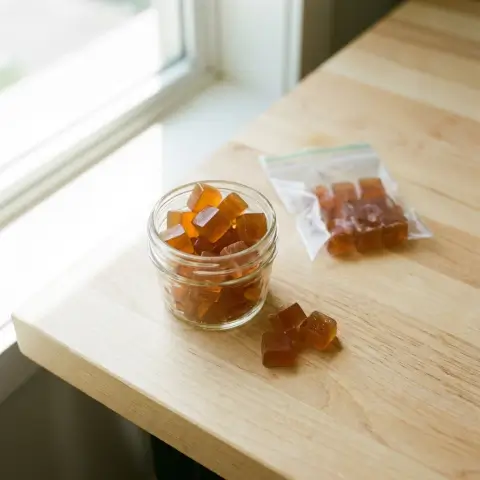
Homemade Energy Gummies

Homemade Honey & Banana Energy Gel
And for something you can chew rather than squeeze:
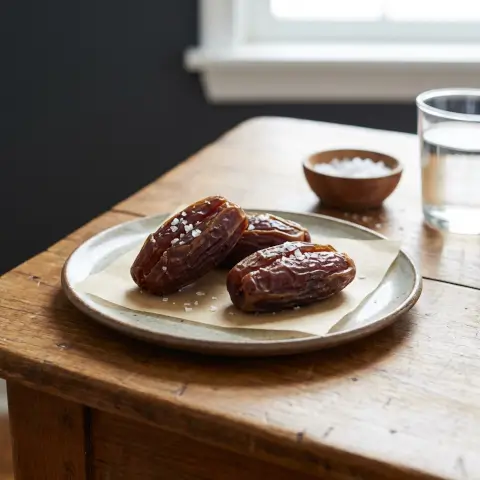
Medjool Date & Sea Salt Chews
When Real Food Shines
Real food tends to outperform gels in two specific situations: long efforts and late-race palatability.
In shorter efforts or early in a race, gels are efficient and unobtrusive. But somewhere around the two-hour mark, flavour fatigue becomes real. The same concentrated sweetness that was fine at kilometre 15 becomes genuinely difficult to consume at kilometre 35. Runners who rely entirely on gels often find themselves skipping fuel in the final third of a marathon – exactly when they need it most.
Real food is easier to keep eating late in a race because it's more varied, less sweet, and often more satisfying. A rice ball, a piece of banana, a date – these feel like food rather than a medical intervention.
The GI tolerance angle also favours real food for longer efforts. Gels can cause problems through their concentrated sugar load and the osmotic effect of pulling fluid into the gut. Real food, consumed in appropriate amounts with water, tends to distribute its carbohydrate load more gradually.
When Gels Make More Sense
For faster runners, gels have a real advantage. At high intensities, you need carbohydrates quickly and in precise doses. The convenience of a gel – tear, squeeze, done – has genuine value when pace and focus matter.
Gels are also easier to plan around. You know exactly how many grams each packet contains, which makes it straightforward to calculate your hourly intake. Real food requires more thought about portion sizing and carrying logistics.
The honest answer is that most recreational runners don't need to choose one or the other. A mixed approach – gels for convenience early in the race, real food for variety and palatability later – works well and is how many experienced marathoners fuel.
When to Start and How Often
The timing question matters as much as what you eat. Waiting until you feel tired to start fueling is too late – by the time fatigue registers, your blood glucose has already dropped and your absorption efficiency is impaired.
The evidence points toward starting somewhere around 30 minutes into the race, then fueling consistently every 30 minutes throughout. [5] Starting from kilometre 1 is unnecessary when glycogen stores are full. Waiting until 45 minutes or later means you're playing catch-up. Thirty minutes in, every thirty minutes after – a reliable default that works across most paces and finish times.
Train Your Gut First
Whatever you eat during a marathon – gel, date, rice cake, or homemade chew – none of it works reliably on race day if you haven't practiced it in training. Your gut's ability to process carbohydrates while running is trainable, not fixed.
A 2023 systematic review found that just two weeks of consistent carbohydrate feeding during runs reduced gut discomfort by up to 47% and decreased carbohydrate malabsorption by 45 to 54%. [6] The protocol is straightforward: start at whatever amount feels comfortable, increase gradually each week, and always practice with your actual race-day fuel. The runners who never have stomach problems on race day aren't lucky – they've done the work in training.
The Practical Takeaway
Commercial gels are a valid tool. But they're not mandatory, and they're not inherently superior to real food alternatives. What matters is hitting your carbohydrate target, using a glucose-fructose source, starting early enough, and having practiced your exact plan in training.
If you find gels unpleasant, expensive, or difficult to stomach late in a race, real food is a legitimate and well-supported alternative. The best marathon fuel is the one you can consistently eat, absorb, and tolerate – from kilometre 5 to kilometre 42.
Every during-run recipe in Fuel.fit is built around the right sugar ratios for absorption during exercise – real food that works the same way as the gels, without the ingredient list.
Sources
[1] Too BW, Cicai S, Hoshi RA, Buford T, et al. Natural versus commercial carbohydrate supplementation and endurance running performance. J Int Soc Sports Nutr. 2012;9:27.
[2] Burke LM, Hawley JA, Wong SH, Jeukendrup AE. Carbohydrates for training and competition. J Sports Sci. 2011;29(Suppl 1):S17-27.
[3] Jeukendrup AE. The optimal ratio of carbohydrates. MySportScience. 2024.
[4] Alkaabi JM, Al-Dabbagh B, Ahmad S, et al. Glycemic indices of five varieties of dates in healthy and diabetic subjects. Nutr J. 2011;10:59.
[5] Runner's World. The complete marathon fueling guide. 2024.
[6] Martinez I, Mika A, Biesiekierski J, Costa R. The effect of gut-training and feeding-challenge on markers of gastrointestinal status in response to endurance exercise: a systematic literature review. Sports Med. 2023;53(9):1709-1728.