
Long runs have a way of humbling you. You find your rhythm, the legs feel good, and for a while everything clicks. Then at some point, something shifts. The pace that felt easy starts to feel like work. Your legs go heavy. The last stretch becomes a negotiation with yourself.
Most of the time, that's not a fitness problem. It's a fuel problem.
The good news is that eating well around long runs isn't complicated. It doesn't require tracking macros or timing supplements to the minute. It's mostly about showing up with a few good habits and then figuring out what actually works for your body.
The Night Before: Don't Skip Dinner

You track your miles.
We'll handle the meals.
Try Fuel App NowBETAWill eventually be released to the Apple App Store and Android Play Store.


Your body stores carbohydrates as glycogen in your muscles and liver. That glycogen is what you run on. The thing most runners don't realize is that what you eat the night before matters just as much as what you eat the morning of – because those stores get topped up while you sleep. The pasta dinner before a race isn't a myth. It works because you're stocking the shelves the night before they need to be full.
A solid carbohydrate-focused dinner the evening before your long run – pasta, rice, potatoes, whatever you actually enjoy – sets you up better than any morning ritual. Keep it relatively low in fiber so your gut is settled when you wake up. Nothing extreme, just a proper meal.
The Classic Marinara Spaghetti is exactly this kind of meal – satisfying, easy to make, and your legs will thank you the next morning:
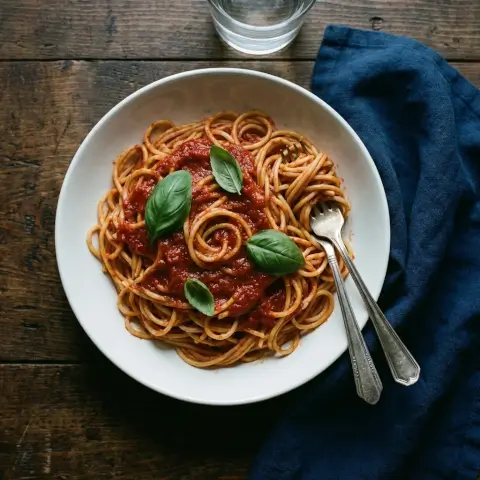
Classic Marinara Spaghetti
The Morning Of: Simple and Familiar
A couple of hours before you head out, eat something you know works for you. Easy-to-digest carbohydrates, a bit of protein, not too much fat or fiber. This isn't the time to try a new recipe or eat something heavy. Your stomach needs time to settle before you ask it to run.
If you prep the night before, morning becomes effortless:
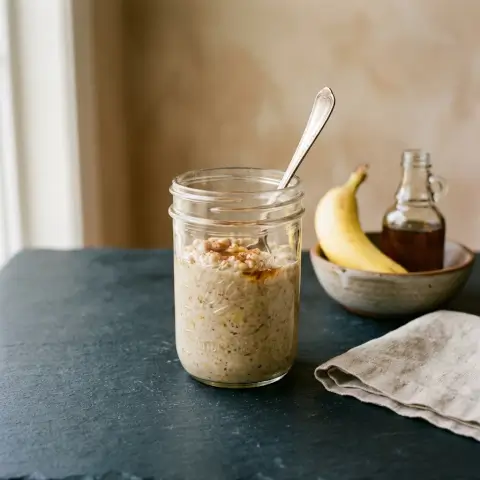
Maple Banana Overnight Oats
If you only have 30 minutes before you go, go smaller and simpler. A banana, a rice cake, a small smoothie. Your liver glycogen drops overnight [1] and even a small carbohydrate hit before a morning run helps stabilize your blood sugar for the effort ahead.
During the Run: Train Your Gut, Not Just Your Legs
This is the section where most runners make their biggest fueling mistake: waiting for hunger, heaviness, or a drop in energy before reaching for food. By the time those signals arrive, your glycogen is already critically low and your gut's ability to absorb carbohydrates is compromised. Playing catch-up from a depleted state is far harder than staying ahead of it.
The evidence-based approach is to start fuelling proactively at around 30 to 45 minutes into a long run, before you feel any need to, and take something every 30 minutes after that. Consistent small doses keep glycogen topped up and your gut processing steadily throughout the effort — which is far more effective than a single large intake when you're already struggling.
The general guideline is 30 to 60 grams of carbohydrate per hour for longer efforts. [2] More trained runners targeting faster marathon times can work up to 60 to 90 grams of carbohydrates per hour from all sources combined — gels, chews, dates, sports drinks, whatever you take on the move — but this requires deliberate gut training over several weeks, combining glucose and fructose sources so both intestinal transport pathways are used simultaneously. Commercial gels work fine, but real food works just as well and many runners find it easier on the stomach over a long effort. Dates, banana pieces, rice cakes, homemade gummies – anything with simple sugars that you enjoy eating.
One thing worth knowing: glucose and fructose together absorb faster than either one alone because they use different pathways in the gut. [3] That's why honey, maple syrup, and dates work so well as running fuel. It's also why homemade options can be just as effective as anything you'd buy at a running store.
Here are two you can make at home and experiment with on your next long run:
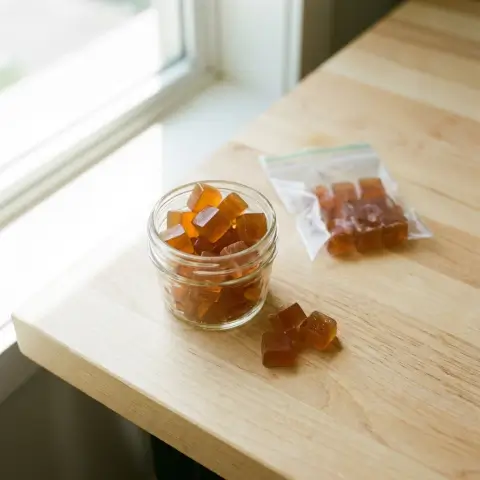
Homemade Energy Gummies

Homemade Honey & Banana Energy Gel
The most important thing here is practice. Your gut adapts to eating while running, but only if you actually do it. If you've never fueled during a run before, start with something small next time and build from there. Don't save the experiment for race day.
Hydration: Drink to Thirst
Drink when you're thirsty. That's mostly it. The old advice of drinking as much as possible has been replaced by something simpler – your thirst is a reasonably good signal.
For longer runs, add some electrolytes. Sweat takes sodium and potassium with it, and plain water doesn't replace them. You don't need a fancy sports drink – a pinch of salt, a splash of maple syrup, and some lemon juice in water gets you there:

Maple Citrus Electrolyte Drink
After the Run: Eat Something Real
Here's where a lot of runners leave recovery on the table. You finish, feel relieved, maybe not very hungry, and eat lightly for the rest of the day. Then the run a couple of days later feels flat and you can't figure out why.
Your body is still restocking glycogen and repairing muscle tissue for hours after you stop. The early recovery window responds particularly well to a combination of carbohydrates and protein. [4] [5] You don't need to obsess over ratios. Just eat something real, with both carbs and protein, and eat it sooner rather than later.
When appetite is low right after a long run, liquid is easier:
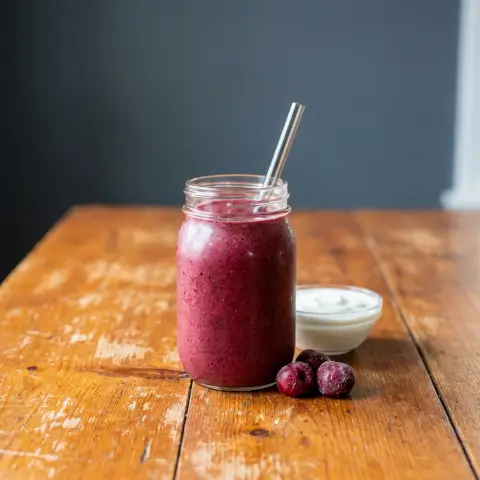
Tart Cherry Smoothie
Tart cherries are worth including here – two independent trials with runners found they meaningfully reduced muscle soreness and sped up recovery compared to placebo. [6] [7] Once your appetite comes back, sit down to a proper meal:
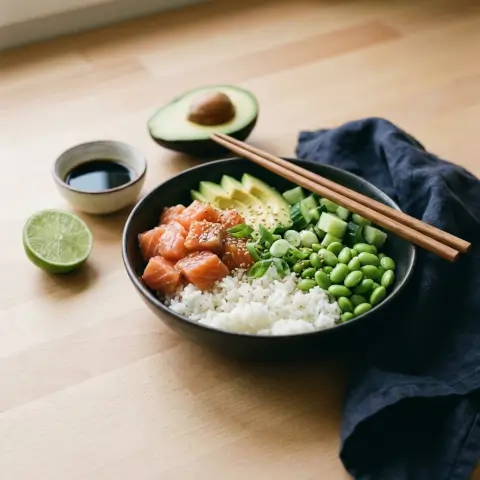
Salmon Poke Bowl
Figure Out What Works for You
Every runner is different. What your training partner eats before a long run might not work for you at all. A food that sits perfectly in cool weather might cause problems in the heat. Something that works great early in a run might not late in one.
None of that is a failure. It's just information. The runners who have the best long run days aren't following a perfect protocol – they've spent time experimenting in training and built a small rotation of things that reliably work for their body.
Use your long runs as the laboratory. Try the overnight oats for a few weeks. Test a homemade gel. See how your legs feel a couple of days later when you actually eat a real recovery meal versus when you don't. Pay attention to what your body tells you.
The goal isn't perfection. It's building a simple routine you actually enjoy, so fueling becomes one less thing to think about and you can just focus on the running.
Every recipe in Fuel.fit is tagged by training context – pre-run, during-run, and recovery – so you always have something that fits where you are in your day.
Sources
[1] Gonzalez JT, Fuchs CJ, Betts JA, van Loon LJ. Liver glycogen metabolism during and after prolonged endurance-type exercise. Am J Physiol Endocrinol Metab. 2016;311(3):E543-E553.
[2] de Oliveira EP, Burini RC, Jeukendrup A. Gastrointestinal complaints during exercise: prevalence, etiology, and nutritional recommendations. Sports Med. 2014;44(Suppl 1):S79-S85.
[3] Jentjens RL, Moseley L, Waring RH, Harding LK, Jeukendrup AE. Oxidation of combined ingestion of glucose and fructose during exercise. J Appl Physiol. 2004;96(4):1277-1284.
[4] Ivy JL, Goforth HW Jr, Damon BM, McCauley TR, Parsons EC, Price TB. Early postexercise muscle glycogen recovery is enhanced with a carbohydrate-protein supplement. J Appl Physiol. 2002;93(4):1337-1344.
[5] Kerksick CM, Harvey T, Stout J, et al. International Society of Sports Nutrition position stand: nutrient timing. J Int Soc Sports Nutr. 2008;5:17.
[6] Howatson G, McHugh MP, Hill JA, et al. Influence of tart cherry juice on indices of recovery following marathon running. Scand J Med Sci Sports. 2010;20(6):843-852.
[7] Kuehl KS, Perrier ET, Elliot DL, Chesnutt JC. Efficacy of tart cherry juice in reducing muscle pain during running: a randomized controlled trial. J Int Soc Sports Nutr. 2010;7:17.