
Few things ruin a run faster than your stomach turning against you. You planned the route, laced up, hit your pace, and then it starts. Cramping, bloating, nausea, or worse. Suddenly the run becomes a frantic search for the nearest washroom.
If this sounds familiar, you are not alone. Studies estimate that anywhere from 30 to 90 percent of endurance athletes experience some form of gastrointestinal distress during training or competition. [1] [7] For runners specifically, the numbers tend toward the higher end because of the repetitive mechanical jostling that running puts on your gut.
The good news is that most GI issues during running are preventable. They come down to what you eat, when you eat it, and how you train your gut to handle fuel under stress.
Why Running Wrecks Your Stomach

You track your miles.
We'll handle the meals.
Try Fuel App NowBETAWill eventually be released to the Apple App Store and Android Play Store.


During exercise, your body redirects blood flow away from your digestive system and toward your working muscles. At moderate to high intensity, blood flow to the gut can drop by as much as 80 percent. [2] [3] That means anything sitting in your stomach gets processed much more slowly than it would at rest.
Add in the mechanical bouncing of running, where every footstrike sends a small jolt through your abdominal cavity, and you have a recipe for trouble. The combination of reduced blood flow and physical agitation is why runners experience more GI problems than cyclists or swimmers doing comparable efforts. [3]
This is not a sign of weakness or a sensitive stomach. It is a predictable physiological response, and once you understand the mechanics, you can work around them.
The Pre-Run Meal Window
The single biggest factor in mid-run GI distress is what you ate before the run and how long ago you ate it. Most problems trace back to eating too much, too close to the start, or choosing the wrong foods.
A general rule is to finish your main pre-run meal at least two to three hours before running. This gives your stomach time to empty and move food into the small intestine, where it causes far fewer problems. If you only have 30 to 60 minutes, keep it small and simple. A banana, a few rice cakes with a thin spread of jam, or a small portion of white rice.
The foods that cause the most trouble tend to be high in fiber, fat, or protein. These all slow gastric emptying, meaning they sit in your stomach longer. A salad with avocado and grilled chicken is a great meal, but not 90 minutes before a tempo run. Save it for after.

Maple Banana Overnight Oats
When you only have 30 to 60 minutes, liquid fuel is your best option – fast-digesting, easy on the stomach, and no solid mass sitting in your gut while you run.

Tropical Mango Smoothie
Fiber: The Misunderstood Villain
Runners hear constantly that fiber is healthy, and it is. But fiber and running have a complicated relationship. Insoluble fiber (found in raw vegetables, whole grains, seeds, and the skins of fruits) adds bulk to digestion and speeds up transit through the colon. During a run, that transit can speed up even further, leading to urgency and cramping.
If you are prone to GI issues, try reducing fiber intake in the 12 to 24 hours before a hard session or long run. This does not mean cutting out vegetables permanently. It means choosing white rice over brown rice, peeled potatoes over lentils, and simple oats over a high-fiber bran cereal in the meals leading up to your run.
Many elite runners follow a low-residue eating pattern the day before races, leaning on white bread, pasta, rice, bananas, and well-cooked vegetables. It is not glamorous nutrition, but it works.
During-Run Fueling and Your Gut
For runs over 60 to 75 minutes, you need to take in fuel while running. This is where many runners hit a wall, not because the nutrition itself is bad, but because their gut is not trained to process food during exercise.
Your gut is adaptable. Research shows that regularly practising during-run fueling can significantly improve gastric tolerance over time. [6] Start small. If you have never eaten during a run, begin with a few sips of a sports drink or a single date during a long run. Over the course of several weeks, gradually increase the amount until you can comfortably take in 30 to 60 grams of carbohydrate per hour. [1]
The type of fuel matters too. Simple sugars like glucose, fructose, and sucrose absorb faster than complex starches. A combination of glucose and fructose actually absorbs faster than either one alone because they use different transport mechanisms in the small intestine. [5] This is why most commercial gels use a glucose-fructose blend, and why homemade options like energy gummies, honey-based gels, or date chews work well. The traditional 2:1 glucose-to-fructose ratio remains adequate for most recreational runners targeting 30-60g per hour. More recent research points to a 1:0.8 ratio as superior for higher intake rates — but for most runners, the natural ratio in honey and maple syrup (close to 1:1) works well without overthinking it.
Here's how to make both at home – no artificial ingredients, right sugar ratios, and tested for gut tolerance:
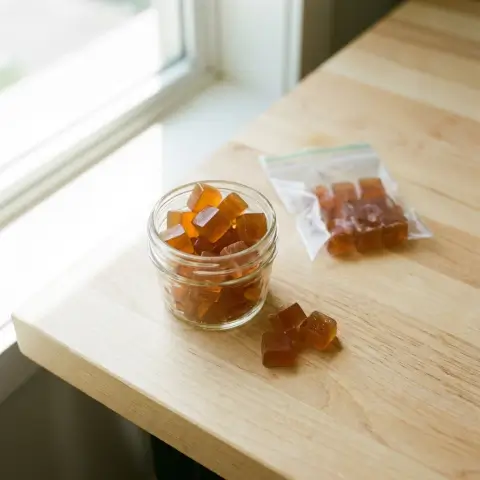
Homemade Energy Gummies

Homemade Honey & Banana Energy Gel
Concentration is another factor. Highly concentrated carbohydrate solutions (anything much above 8 percent carbohydrate) can pull water into your intestine through osmosis, causing bloating and diarrhea. If you are mixing your own drinks, keep them dilute. A pinch of salt, some maple syrup, and lemon juice in water gives you electrolytes and energy without overloading your gut.
The Maple Lemon Electrolyte Drink is built on exactly this formula:

Maple Citrus Electrolyte Drink
Hydration Mistakes That Cause GI Problems
Dehydration and overhydration can both cause stomach trouble during a run. When you are dehydrated, blood flow to the gut drops even further than it would normally during exercise, amplifying every other GI risk factor.
On the flip side, drinking too much water too quickly can cause a sloshing sensation, nausea, and in extreme cases, hyponatremia (dangerously low blood sodium). The old advice of drinking as much as possible during a run has been replaced by a simpler approach: drink to thirst.
In practice, this usually means 400 to 800 millilitres per hour depending on conditions and sweat rate, taken in small sips rather than large gulps. If you are running long enough to need fuel, combining your carbohydrates with your fluid (a sports drink rather than gels plus water) can reduce total gut volume and lower the chance of stomach issues.
Common Triggers to Watch For
Beyond the general principles of timing and food composition, some specific triggers are worth knowing about.
Caffeine in moderate doses (1 to 3 mg per kilogram of body weight) improves performance for most runners, but higher doses or caffeine on an empty stomach can stimulate gut motility and cause urgency. If you drink coffee before a run, give yourself enough time for it to "do its thing" before heading out.
NSAIDs like ibuprofen are commonly used by runners for aches and pains, but they significantly increase intestinal permeability during exercise. [4] Taking ibuprofen before a run raises your risk of GI distress substantially. Save it for after, or better yet, address the root cause of the pain.
Artificial sweeteners, especially sugar alcohols like sorbitol and mannitol found in many "sugar-free" products and protein bars, are notorious for causing bloating and diarrhea. Check the ingredient list of any pre-run snack or during-run fuel.
Dairy can be problematic for some runners, even those who are not lactose intolerant at rest. Reduced blood flow to the gut during exercise can impair lactose digestion temporarily. If you notice a pattern, try switching your pre-run meals to dairy-free options for a few weeks and see if it helps.
Building a GI-Friendly Routine
The runners who never seem to have stomach problems are not genetically blessed. They have systems. They eat the same pre-run meals, at the same times, and they test every piece of race-day nutrition months in advance.
Start by identifying your personal triggers. Keep a simple log for two to three weeks: what you ate, when you ate it, what you ran, and how your stomach felt. Patterns emerge quickly. Maybe it is the granola bar you grab 30 minutes before a run. Maybe it is the large coffee without food. Maybe it is the high-fiber dinner the night before a long run.
Once you know your triggers, build a pre-run eating routine around foods that you know work. Stick with it for training and replicate it exactly on race day. The goal is to remove stomach issues from the equation entirely so you can focus on the actual running.
Real Food That Works
One of the reasons we built Fuel.fit around training context is exactly this problem. Every recipe is tagged with its intended timing, so pre-run meals are already designed to be low-fiber and easy to digest, and during-run fuel options use real food ingredients in the right ratios for gut tolerance. Instead of guessing whether a meal will sit well before your tempo run, you are choosing from options that were built with your stomach in mind.
Your gut is trainable, your food choices are controllable, and your race-day stomach problems are solvable. It just takes a bit of structure and consistency.
Tired of guessing what will sit well before a run? Fuel.fit gives you runner-tested recipes tagged by timing, so your stomach never has to be the experiment.
Sources
[1] de Oliveira EP, Burini RC, Jeukendrup A. Gastrointestinal complaints during exercise: prevalence, etiology, and nutritional recommendations. Sports Med. 2014;44(Suppl 1):S79-S85.
[2] van Wijck K, Lenaerts K, van Loon LJ, Peters WH, Buurman WA, Dejong CH. Exercise-induced splanchnic hypoperfusion results in gut dysfunction in healthy men. PLoS One. 2011;6(7):e22366.
[3] ter Steege RW, Kolkman JJ. Review article: the pathophysiology and management of gastrointestinal symptoms during physical exercise, and the role of splanchnic blood flow. Aliment Pharmacol Ther. 2012;35(5):516-528.
[4] van Wijck K, Lenaerts K, van Bijnen AA, et al. Aggravation of exercise-induced intestinal injury by ibuprofen in athletes. Med Sci Sports Exerc. 2012;44(12):2257-2262.
[5] Jentjens RL, Moseley L, Waring RH, Harding LK, Jeukendrup AE. Oxidation of combined ingestion of glucose and fructose during exercise. J Appl Physiol. 2004;96(4):1277-1284.
[6] Cox GR, Clark SA, Cox AJ, et al. Daily training with high carbohydrate availability increases exogenous carbohydrate oxidation during endurance cycling. J Appl Physiol. 2010;109(1):126-134.
[7] ter Steege RW, Van der Palen J, Kolkman JJ. Prevalence of gastrointestinal complaints in runners competing in a long-distance run: an internet-based observational study in 1281 subjects. Scand J Gastroenterol. 2008;43(12):1477-1482.