
This article is for informational purposes only, not medical advice. Caffeine affects everyone differently — if you have health concerns or take medication, check with a healthcare professional before changing your intake habits.
You already know caffeine wakes you up. But what most runners don't realize is that their morning coffee is one of the most well-researched legal performance enhancers in sports. The science isn't subtle either: meta-analyses consistently show that caffeine improves endurance running performance, and the effect holds across recreational joggers and elite athletes alike. [1] [2]
The catch is that most runners use caffeine randomly. A coffee to wake up, maybe another before an afternoon run, possibly a gel with caffeine at kilometer 25. That scattershot approach means you're either not getting the benefit when it counts, or you're wrecking your sleep and undermining the recovery that actually makes you faster.
Here's how caffeine actually works for runners, and how to use it strategically.
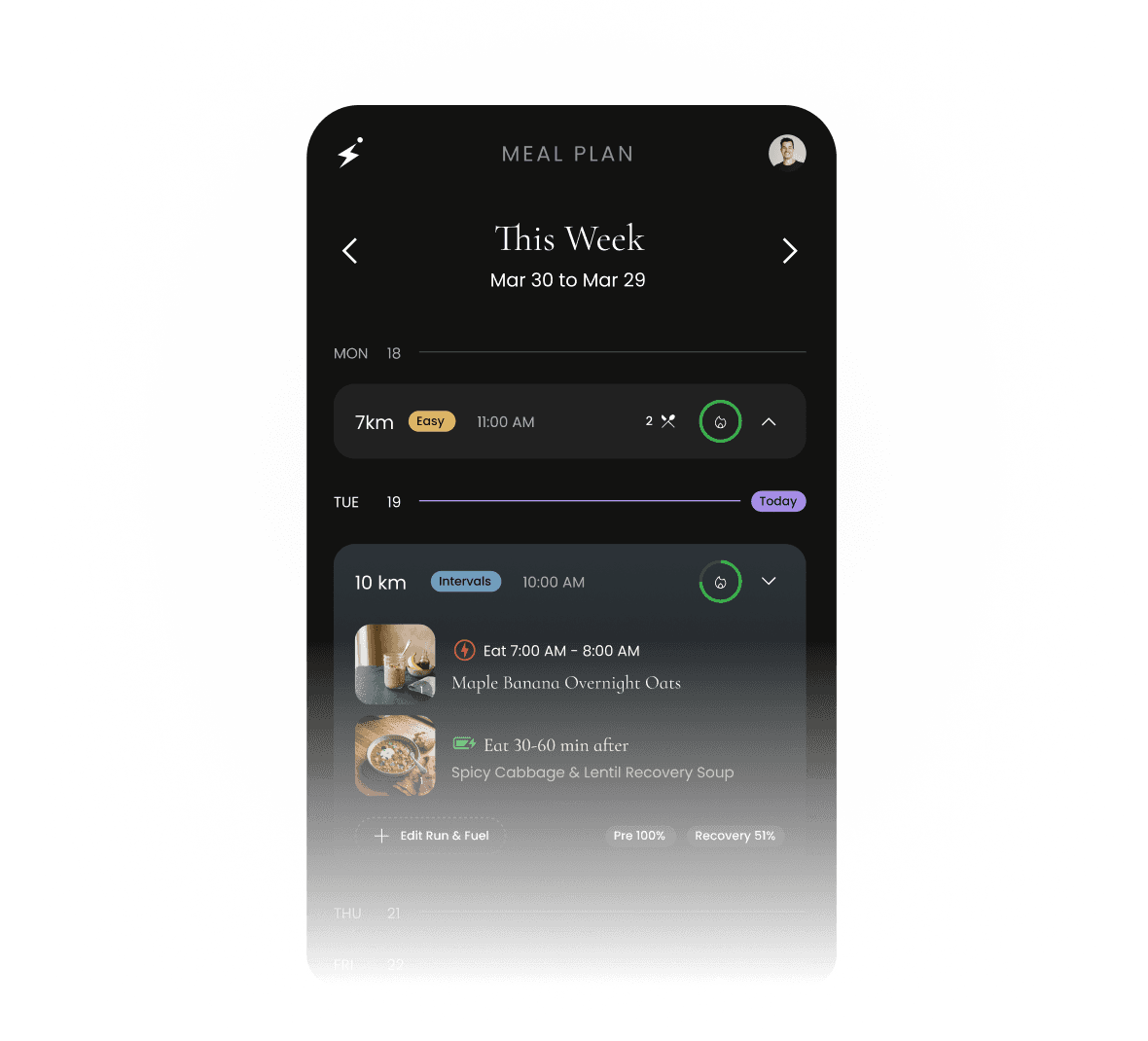
You track your miles.
We'll handle the meals.
Try Fuel App NowBETAWill eventually be released to the Apple App Store and Android Play Store.


What Caffeine Does to Your Body During a Run
Caffeine doesn't give you energy in the way carbohydrates do. It contains essentially zero usable calories. Instead, it works by blocking adenosine receptors in your brain. Adenosine is the molecule that accumulates throughout the day and tells your nervous system "you're tired, slow down." Caffeine parks itself in those receptors and prevents that signal from getting through.
The downstream effects matter for runners. With adenosine blocked, your brain increases the activity of dopamine and norepinephrine. You perceive less effort at the same pace. Your muscles feel less fatigued. Your reaction time improves and your focus sharpens. You're not actually less tired in a physiological sense, but your brain's perception of that fatigue is dampened, which means you can push harder for longer before your body tells you to stop.
A 2022 meta-analysis of 21 randomized controlled trials found that caffeine significantly improved both time-to-exhaustion and time-trial performance in runners. The average performance improvement in time trials sits around 1-3%, which might sound small until you do the math: for a 1:45 half marathon runner, a 2% improvement is over two minutes. [1]
How Much You Actually Need
Sports nutrition guidelines suggest taking caffeine about 60 minutes before exercise. [2] Starting at the lower end of your personal tolerance is smart. More caffeine doesn't always mean more performance, and the side effects — jitteriness, GI distress, elevated heart rate, anxiety — can start to outweigh the benefits as intake climbs. If you've ever felt your stomach churn during a race after doubling up on caffeinated gels, you've experienced this firsthand.
Research also shows that lower doses can still provide meaningful benefits, especially for runners who aren't habitual heavy caffeine users. [2] You don't need to push toward maximum intake to get a real performance edge. A cup of coffee before a key workout may be all you need.
The right amount depends on your body weight, your sensitivity, your tolerance, and how your gut responds under running conditions. What matters more than any specific number is paying attention to how your body responds and building your strategy from there.
Timing: When to Take It and When to Stop
Caffeine reaches peak concentration in your blood about 45-60 minutes after you consume it. So the standard advice of "coffee an hour before your run" is backed by pharmacokinetics, not just tradition.
The more important number is caffeine's half-life: 5-6 hours on average, though this varies significantly between individuals. Half-life means the time it takes for your body to eliminate half the caffeine you consumed. A cup of coffee in the afternoon can still have a meaningful amount of caffeine circulating in your system hours later as you're trying to wind down for bed.
This is where most runners sabotage themselves. Research shows that caffeine consumed in the hours before bedtime can reduce total sleep time and sleep quality. [3] For evening runners, a caffeinated pre-run boost in the late afternoon could still be disrupting your sleep by 11 PM.
And sleep is not optional for runners. It's when your body repairs muscle damage, consolidates training adaptations, and releases growth hormone. Sacrificing sleep quality for a slightly better Tuesday tempo run is a losing trade over any meaningful timeframe.
The practical rule: if your run is in the morning, caffeine is straightforward. Coffee an hour before, no worries. If you run in the late afternoon or evening, you need to decide whether the performance boost is worth the potential sleep cost. For most training runs, it's not. Save the caffeine strategy for races and key workouts that happen early enough in the day.
Caffeine for Different Run Types
Not every run benefits equally from caffeine. Here's when it actually matters:
Long runs and races (10K+): This is where caffeine earns its reputation. The longer the effort, the more fatigue perception matters, and the more caffeine helps. For very long events like marathons or ultras, the caffeine from your pre-race dose will metabolize during the race, so some runners add small additional doses through caffeinated gels, chews, or even flat cola in the later stages. What matters is that you've tested this approach in training first.
Speed workouts and tempo runs: Caffeine can help you hit paces that feel harder than usual, particularly on days when you're slightly fatigued from accumulated training. The reduced perception of effort is genuinely useful for interval sessions where mental toughness determines whether you complete the last rep.
Easy and recovery runs: Skip it. These runs should feel easy. Caffeine pushes you to go harder, which defeats the purpose of a recovery session. It also means one more dose contributing to your daily caffeine load and potentially affecting sleep.
Race day: This is the main event for caffeine use. Take your tested dose about 60 minutes before the start. If you're running a half marathon or longer, consider a caffeinated gel in the second half. Don't try anything new on race day, and that includes a dose higher than what you've practiced in training.
The Tolerance Problem
If you drink three coffees every day, does caffeine still help your running? The research here is nuanced. Cross-sectional studies suggest that habitual caffeine users still get performance benefits from acute supplementation before exercise, even at the same dose they consume daily. [4] Your body may adapt to caffeine's effects on alertness and wakefulness, but the exercise performance benefit appears more resilient.
That said, some controlled studies where athletes consumed caffeine daily for several weeks showed that the ergogenic effect was strongest on the first day and diminished over time. [4] The practical takeaway: if you're a heavy daily caffeine user, you'll probably still get some benefit from pre-race caffeine, but the effect may be blunted compared to someone who uses it more sparingly.
Some runners cycle caffeine before big races, cutting back to minimal intake for 7-10 days before race day to resensitize their adenosine receptors, then using a full dose on race morning for maximum impact. The evidence for this strategy is mostly anecdotal, but the underlying pharmacology makes sense.
The Genetic Factor
Not everyone responds to caffeine the same way, and genetics explain a lot of the variation. The CYP1A2 gene determines how fast your liver metabolizes caffeine. [5] People with the AA genotype are "fast metabolizers" who clear caffeine quickly, while those with the AC or CC genotype are "slow metabolizers" who keep caffeine in their system much longer.
For fast metabolizers, caffeine tends to be more ergogenic and less disruptive to sleep. For slow metabolizers, the same dose can linger for hours longer, increasing the risk of jitteriness, GI problems, and insomnia without necessarily providing a bigger performance boost.
You don't need a genetic test to figure out where you fall. If a single afternoon coffee keeps you up at night, you're likely a slow metabolizer. If you can drink espresso after dinner and sleep fine, you're probably a fast one. Adjust your approach accordingly.
GI Distress: The Runner's Caffeine Trap
Caffeine stimulates gastric acid secretion and increases gut motility. [6] For a runner already dealing with the mechanical jostling of running and reduced blood flow to the gut during exercise, adding caffeine can push things over the edge. This is especially true at higher doses and when caffeine is consumed on a relatively empty stomach.
If you've experienced mid-run stomach issues after caffeinated gels, the caffeine may be a contributing factor alongside the sugar content. Some strategies that help: take your caffeine with a small amount of food (a banana, a piece of toast), keep doses on the conservative side, and practice your race-day caffeine strategy during training runs so your gut can adapt.
How to Build Your Caffeine Strategy
Start simple and test everything in training, never in a race.
For your next key workout or long run, try a single cup of coffee about 60 minutes before you start. Note how you feel during the run: perceived effort, stomach comfort, energy levels. On a separate similar workout, run without caffeine and compare.
Once you've established your baseline, you can experiment with timing (45 vs 60 minutes before) and source (coffee vs gel vs caffeine pill). Keep a mental log of what works. If you tolerate it well and want to test a slightly higher intake, do it during training, not on race day.
For races, your caffeine plan should be locked in weeks before the start. You should know your approach, your timing, and your source, and you should have practiced it at least two or three times in training.
The goal isn't to maximize caffeine. It's to find the minimum effective amount that improves your performance without side effects. For most recreational runners, that's probably a lot less than you think.
If caffeine is part of your pre-run strategy, these two real-food options pair well with it – one for the performance angle, one as your main pre-run meal:

Beetroot & Ginger Run Shot

Maple Banana Overnight Oats
Sources
[1] Wang Z, Qiu B, Gao J, Del Coso J. Effects of caffeine intake on endurance running performance and time to exhaustion: a systematic review and meta-analysis. Nutrients. 2023;15(1):148.
[2] Guest NS, VanDusseldorp TA, Nelson MT, et al. International Society of Sports Nutrition position stand: caffeine and exercise performance. J Int Soc Sports Nutr. 2021;18(1):1.
[3] Drake C, Roehrs T, Shambroom J, Roth T. Caffeine effects on sleep taken 0, 3, or 6 hours before going to bed. J Clin Sleep Med. 2013;9(11):1195-1200.
[4] Gonçalves LS, Painelli VS, Yamaguchi G, et al. Inconsistency in the ergogenic effect of caffeine in athletes who regularly consume caffeine: is it due to the disparity in the criteria that defines habitual caffeine intake? Nutrients. 2020;12(5):1328.
[5] Pickering C, Kiely J. What should we do about habitual caffeine use in athletes? Sports Med. 2019;49(6):833-842.
[6] Somoza V, et al. Caffeine induces gastric acid secretion via bitter taste signaling in gastric parietal cells. Proc Natl Acad Sci USA. 2017;114(30):E6260-E6269.