
Most runners think of nutrition as something you plan before a race. The gel brand, the timing, the number of packets. What they don't plan for is that their gut might simply refuse to cooperate – not because the plan was wrong, but because the gut was never trained to follow it.
Your digestive system is not a passive passenger during a run. It's an active participant, and like everything else in your body, it adapts to the demands you place on it. Train it consistently and it will handle fuel efficiently. Ignore it and it will remind you, loudly, somewhere around kilometre 30.
Why Running Is Hard on the Gut
During a run, your body redirects blood flow away from the digestive system and toward your working muscles. At moderate to high intensity, splanchnic blood flow – the circulation feeding your gut – can drop by as much as 80 percent. [1] This means food and fuel you consume mid-run gets processed in a gut that's working with a fraction of its usual capacity.

You track your miles.
We'll handle the meals.
Try Fuel App NowBETAWill eventually be released to the Apple App Store and Android Play Store.


Add in the repetitive mechanical bouncing of running – which physically jolts the contents of your intestines with every footstrike – and you have a combination that cyclists, swimmers, and rowers simply don't experience at the same intensity. It's why runners report GI distress far more often than other endurance athletes doing comparable efforts.
None of this is a reason to avoid fueling. It's a reason to practice.
What Gut Training Actually Is
Gut training is the practice of regularly consuming carbohydrates during your training runs, in amounts and formats that mimic what you'll eat on race day. The goal is to gradually increase the volume your gut can handle without distress.
The underlying mechanism involves two things. First, repeated exposure to carbohydrates during exercise upregulates the intestinal transporters – SGLT1 for glucose and GLUT5 for fructose – that absorb sugars from your gut into your bloodstream. [2] More transporters means faster, more efficient absorption. Second, consistent practice simply habituates your gut to the mechanical and physiological stress of processing food while running, reducing the discomfort response over time.
A 2023 systematic review found that just two weeks of consistent carbohydrate feeding during runs reduced gut discomfort by up to 47% and decreased carbohydrate malabsorption by 45 to 54%. [3] Those are meaningful numbers from a short intervention. The implication is clear: most GI problems on race day are not inevitable – they're a consequence of asking the gut to do something it has never been asked to do before.
The Protocol
The approach is simple. On every long run of 90 minutes or more, practice eating what you plan to eat on race day.
Start at a level that feels comfortable – usually around 30 grams of carbohydrate per hour. Every week or two, nudge that amount up by about 10 grams per hour. Over 6 to 10 weeks, most runners can shift their tolerance from 30 grams per hour to 60 grams or more without significant discomfort.
A few things that matter in practice:
Use your actual race-day fuel. The adaptation is partly specific to the product. Training with gels and racing with dates is a different gut experience. Whatever you plan to use on race day, practice with it.
Practice at race-day intensity. An easy 2-hour run is gentler on the gut than a hard marathon-pace effort. If possible, some of your gut training sessions should match the intensity of the race you're preparing for.
Don't skip the fluids. Taking fuel without adequate water increases the concentration of sugar in your gut, which pulls water from your bloodstream into the intestine through osmosis – causing cramping and bloating. Wash everything down.
These are the real-food options worth building your gut training around:

Homemade Energy Gummies

Homemade Honey & Banana Energy Gel
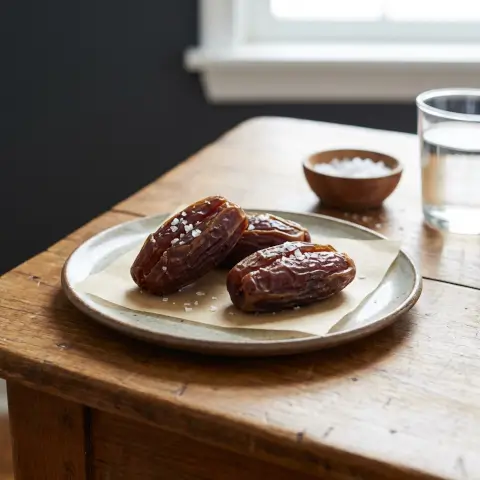
Medjool Date & Sea Salt Chews
The Glucose-Fructose Advantage
One practical detail that makes gut training easier: using a combination of glucose and fructose rather than glucose alone allows for faster absorption because they use different intestinal transporters simultaneously. [4] At 30 to 60 grams per hour – the right range for most recreational runners – this matters less than at higher intakes. But it's worth knowing when choosing your fuel.
Honey, maple syrup, dates, and most commercial gels all provide a natural or formulated glucose-fructose mix. Plain maltodextrin products, which are glucose-only, hit the absorption ceiling faster.
What to Cut Before a Long Run
Gut training is about building tolerance over time. But the day before and the morning of a long run, there are things worth reducing to start from a settled baseline.
High-fiber foods slow gastric emptying and can linger in the colon long enough to cause urgency during a run. Fat slows gastric emptying too, which is exactly what you don't want before an effort. Spicy foods and dairy can cause issues for some runners under the stress of exercise even if they're fine at rest.
In the 12 to 24 hours before a hard long run, many experienced runners lean toward white rice, pasta, bread, bananas, and well-cooked vegetables – not because these are superior nutritionally, but because they clear the system efficiently and leave nothing behind to complicate things.
The Honest Timeline
Two weeks of consistent practice produces measurable improvements. Six to ten weeks is enough to meaningfully shift your tolerance and build a reliable routine. But the runners who never have stomach problems on race day aren't the ones who discovered a special gel or followed a precise protocol. They're the ones who ate during every long run for months and built a quiet confidence in what their body can handle.
Race day is not the time to find out. Every long run is a test and a training session at once. Use them.
Fuel.fit tags all during-run recipes separately from pre-run and recovery options – so when you're building your gut training routine, you're choosing from options designed specifically for eating on the move.
Sources
[1] de Oliveira EP, Burini RC, Jeukendrup A. Gastrointestinal complaints during exercise: prevalence, etiology, and nutritional recommendations. Sports Med. 2014;44(Suppl 1):S79-S85.
[2] Cox GR, Clark SA, Cox AJ, et al. Daily training with high carbohydrate availability increases exogenous carbohydrate oxidation during endurance cycling. J Appl Physiol. 2010;109(1):126-134.
[3] Martinez I, Mika A, Biesiekierski J, Costa R. The effect of gut-training and feeding-challenge on markers of gastrointestinal status in response to endurance exercise: a systematic literature review. Sports Med. 2023;53(9):1709-1728.
[4] Jentjens RL, Moseley L, Waring RH, Harding LK, Jeukendrup AE. Oxidation of combined ingestion of glucose and fructose during exercise. J Appl Physiol. 2004;96(4):1277-1284.