
A bowl of oatmeal with banana is a great meal. But eat it 20 minutes before a speed session and you might find yourself doubled over at the side of the trail. Eat it three hours before that same session, and it becomes rocket fuel.
The goal of pre-run eating is simple: give your body enough accessible energy to perform without causing stomach issues. That balance is the tricky part, and it depends almost entirely on timing.
Getting this wrong doesn't just feel bad. It can derail your entire workout. Getting it right, on the other hand, is one of the easiest performance gains available to any runner. No new gear, no extra training volume. Just the right food at the right time.
The 2-3 Hour Window: Your Main Pre-Run Meal

You track your miles.
We'll handle the meals.
Try Fuel App NowBETAWill eventually be released to the Apple App Store and Android Play Store.


If you have two to three hours before your run, you have time for a proper meal. This is your chance to top off glycogen stores – the carbohydrate reserves in your muscles and liver that serve as your primary fuel source during running.
Your ideal pre-run meal in this window should be built around easily digestible carbohydrates with moderate protein and low fat. Think toast with peanut butter and sliced banana, oatmeal with berries, or a rice bowl with a small portion of chicken. The carbohydrates provide energy, the protein helps stabilize blood sugar, and keeping fat and fiber low reduces the risk of GI distress.
Sports nutrition guidelines suggest roughly 1-4 grams of carbohydrate per kilogram of body weight in the 1-4 hours before a run lasting over 60 minutes. [1] For a 70 kg runner eating 2-3 hours out, the lower end of that range – around 1-2 g/kg – is a practical target. That translates to roughly a large bowl of oatmeal with fruit and honey, or two slices of toast with jam plus a banana.
Two meals built around this 2-3 hour window:

Maple Banana Overnight Oats

Banana Oat Pancakes
The 30-60 Minute Window: Quick Top-Up
Sometimes you don't have two hours. Maybe you're squeezing in a run before work, or your schedule shifted. In the 30-60 minute window before a run, you need something light and fast-digesting.
This is where simple carbohydrates shine: a banana, a piece of white toast with jam, a handful of pretzels, or a rice cake. The key is to avoid anything heavy in fiber, fat, or protein. Those take longer to digest and can cause cramping or nausea during your run.
The Salted Maple Rice Cakes are the simplest option in this window – four ingredients, fast-digesting, and easy on the stomach:

Salted Maple Rice Cakes
Morning Runners: The Fasted Run Debate
If you run first thing in the morning, you've been fasting for 8+ hours. For easy, short runs under 45 minutes, some runners do fine on an empty stomach. But for anything longer or more intense, even a small snack – a banana, a few dates, or a glass of juice – can make a meaningful difference in how you feel and perform.
The reason is straightforward: your liver glycogen drops significantly overnight, because the liver is the only organ that uses its glycogen stores during sleep to maintain blood glucose. [2] Your muscle glycogen stays largely intact until you actually run. So a small carbohydrate hit before a morning run is primarily topping up the liver, not the muscles – but that matters, because it's the liver that keeps blood glucose stable during your run.
What to Avoid Before Running
Some foods are notorious for causing problems during runs, no matter how healthy they are in other contexts. High-fiber vegetables, fatty or fried foods, spicy meals, and excessive caffeine can all trigger GI distress. Studies estimate that anywhere from 30 to 90 percent of endurance athletes experience some form of gastrointestinal distress during training or competition, [3] and most cases are preventable through better food choices and timing.
The golden rule applies here more than anywhere: test everything in training. Every pre-run meal, every snack, every morning routine should be tried and tested well before race day. Your stomach on race morning is not the time for experiments.
How Pre-Run Nutrition Changes by Run Type
Not every run needs the same level of fueling attention.
For easy and recovery runs under an hour, a normal meal a couple of hours beforehand is usually sufficient. Don't overthink it.
For speed work and tempo runs, proper pre-run fueling matters more. High-intensity sessions burn through glycogen faster despite being shorter in duration, so you want full stores going in.
For long runs (90+ minutes), fueling starts the day before. Eat well the evening prior, have a solid pre-run meal 2-3 hours before, and plan your during-run fueling with gels, chews, or real-food options.
The Classic Marinara Spaghetti is the ideal night-before meal – high carbs, low fiber, easy to digest, and genuinely satisfying:
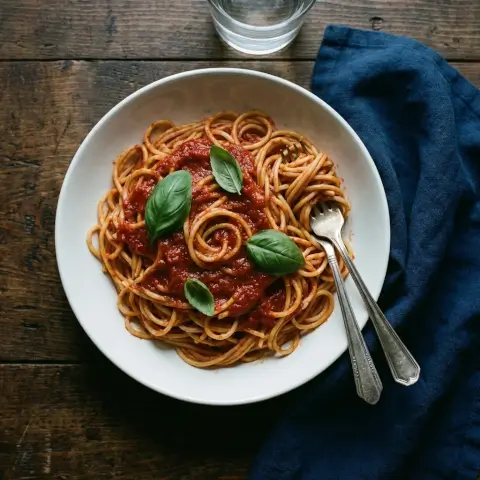
Classic Marinara Spaghetti
For race day, stick to what you've tested in training. A familiar, carb-rich meal 3-4 hours before the start, a small carb-focused snack 30-60 minutes before, and nothing new.
The Right Pre-Run Fuel, Every Time
This is one of the reasons we built Fuel.fit with training context at its core. Every recipe is categorized by timing (pre-run, recovery, or snack), so when you're planning meals before a run, you're choosing from options that are already low-fiber, easily digestible, and carb-forward. It's not about restricting what you eat. It's about having the right food ready at the right time.
Once you nail your pre-run nutrition, the next piece of the puzzle is what happens after you finish. That recovery window matters just as much.
Looking for pre-run meals designed specifically for runners? Try Fuel.fit, where every recipe is built around your training context.
Sources
[1] Wallis GA, Podlogar T. Dietary carbohydrate and the endurance athlete: contemporary perspectives. Sports Sci Exchange. 2022;35(231):1-6.
[2] Gonzalez JT, Fuchs CJ, Betts JA, van Loon LJ. Liver glycogen metabolism during and after prolonged endurance-type exercise. Am J Physiol Endocrinol Metab. 2016;311(3):E543-E553.
[3] de Oliveira EP, Burini RC, Jeukendrup A. Gastrointestinal complaints during exercise: prevalence, etiology, and nutritional recommendations. Sports Med. 2014;44(Suppl 1):S79-S85.